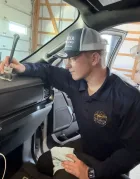
I am Joe Young, owner of Premier Detailing, operating out of Lenexa, KS. I have treated mildew odor in vehicles across Overland Park, Olathe, Leawood, Lenexa, Shawnee, and throughout Johnson County.
Why Kansas Makes This Problem Worse Than Most States
Kansas sits in a climate zone that combines two of the worst conditions for vehicle interiors: high summer heat and significant humidity. Johnson County regularly sees 80-degree-plus temperatures by May with relative humidity above 60 percent through most of the summer.
That cycle, heat, condensation, trapped moisture, is exactly what mold needs. Mold spores are present in the air everywhere.
Where Mildew Smell Actually Comes From in a Car
1. Wet Floor Mat Padding
The most common source in Johnson County: a dog that shook off rain in the back seat, a spilled drink that soaked through the floor mat surface into the padding, or accumulated humidity under floor mats that were not removed and dried periodically. The mat surface may look clean but the padding beneath it is saturated with moisture and the mold is growing in the carpet layer beneath that.
2. Soaked Carpet Backing After a Spill
Any liquid spill in a car interior, coffee, water, a child's sippy cup, a sports drink, that is not extracted immediately soaks through the carpet surface, through the padding, and into the carpet backing. The carpet backing retains moisture for weeks.
3. Leaking Door Seals or Sunroof Drains
Older vehicles in Kansas frequently develop seal issues from UV degradation of rubber door seals and weatherstripping. When a seal fails, water enters during rain and pools under the carpet or in the footwell.
4. HVAC System Mold
The air conditioning evaporator core creates condensation as part of normal operation. In a properly functioning system, that condensation drains out of the vehicle.
5. Wet Dog, The Johnson County Standard
Johnson County has one of the highest dog ownership rates in the Kansas City metro. Off-leash parks in Olathe, creek access in Gardner and Spring Hill, trails throughout Shawnee Mission Park, dogs swim, wade, and get rained on, and then they ride home in the back seat.
What Does Not Work
Important: The following products and methods are commonly tried and consistently fail to eliminate mold and mildew odor from car interiors. Understanding why they fail saves time and money.
| Method | Does It Work? | Why Not |
|---|---|---|
| Air fresheners / hanging deodorizers | No | Adds fragrance on top of the odor. Mold source untreated. |
| Baking soda on carpet | No | Absorbs surface molecules. Does not reach carpet backing. |
| Febreze or fabric spray | No | Surface treatment only. Mold is below the surface layer. |
| Odor bomb / fogger | Temporary | Chemical vapor fills cabin air but does not penetrate carpet. |
| Charcoal odor absorbers | No | Absorbs airborne odor. Does not treat embedded mold. |
| Leaving windows open to air out | No | Does not dry carpet backing. Mold source unchanged. |
| 212°F steam + extraction | Yes | Kills mold at the fiber level. Extraction removes residue. |
The reason these methods fail is consistent: the odor is not in the air. It is in the carpet backing, the padding beneath the carpet, and occasionally the HVAC system.
What Actually Eliminates Mold and Mildew Smell in a Car
Step 1: Find and Fix the Source of Moisture
If the mildew smell is caused by a leaking door seal, a clogged sunroof drain, or a structural water intrusion issue, no cleaning process will permanently solve the problem. The water will keep entering, the mold will keep growing, and the odor will return.
Step 2: Remove Floor Mats and Dry Them Separately
Pull all floor mats out of the vehicle. Inspect the carpet beneath them.
Step 3: 212-Degree Steam on All Carpet and Fabric
I use the commercial steam cleaner, which operates at true 212-degree Fahrenheit output. At that temperature, mold spores are killed on contact.
Every carpet section gets steamed, cargo area, rear floor, front floor on both sides, under the seats including the seat track channels where moisture accumulates. The fabric portions of the rear seat backs and headrest material are steamed as well.
Step 4: Shop Vac Extraction After Steam
The commercial 6.0 HP shop vac extracts the steamed residue from carpet after the heat treatment. Multiple passes with the crevice tool and wide nozzle.
Step 5: HVAC Treatment if Needed
If the mildew smell appears specifically when running the fan, particularly on startup or when switching from recirculate to fresh air, the HVAC system is part of the problem. I treat all visible vents with steam and disinfectant and run the fan to circulate treatment into the ductwork.
How Long Does Mold and Mildew Smell Removal Take?
A straightforward mildew odor from a damp carpet or wet dog situation adds about 30 to 60 minutes to a standard Interior Reset. A vehicle with heavy mold accumulation from multiple water intrusion events or years of wet dog exposure takes longer, closer to the full Interior Reset time plus extraction passes on every carpet section.
Preventing Mildew Smell in Kansas, Going Forward
- Remove floor mats monthly and confirm the carpet beneath is dry. In Johnson County summers, check more frequently if you drive with wet dogs or wet gear.
- Never close a wet dog inside a parked vehicle in summer heat. The moisture from one wet dog in a closed car on an 85-degree Kansas day creates ideal mold conditions within 48 hours.
- Address any liquid spill with extraction immediately. Blotting surface liquid is not enough, use a shop vac on the area within the first hour of any significant spill to pull moisture out of the padding before it sets.
- Check door seals and sunroof drains annually. A $20 seal repair or a $10 canned air clearing of a sunroof drain prevents hundreds of dollars of mold remediation and a permanently ruined carpet.
- Run the AC on fresh air mode periodically. Running AC on recirculate continuously can allow moisture to accumulate in the HVAC system. Switching to fresh air for the last five minutes of a drive allows the system to dry out.
What to Tell Your Detailer Before Booking a Mildew Treatment
When you book, tell me where you think the smell is strongest and how long it has been present. The location helps me identify whether the source is floor carpet, seat fabric, cargo area, or HVAC.
Premier Detailing Services
Related Articles
- How to Get Rid of Smoke Smell in a Car in Kansas
- Car Odor Removal Service Page, All Odor Types
- How to Remove Dog Hair from Car Seats
- Why I Use 212-Degree Steam to Clean Every Car Interior
- Steam Clean vs Shampoo: Full Comparison