Why Smoke Smell Persists in Car Interiors
Cigarette smoke consists of thousands of chemical compounds, many of which are oily and hydrophobic. When smoke enters a car interior, these compounds deposit on the nearest available surface.
Kansas summers compound the problem. When interior temperatures reach 130°F or higher on a parked car, the oils in smoke deposits become volatile again and off-gas into the cabin air.
What Does Not Work
- Air fresheners and odor bombs. These are masking agents. They add a new scent on top of the smoke odor. Within a week, both smells are detectable. The smoke compounds are still on every surface.
- Baking soda. Absorbs some airborne odor molecules but does not touch the oils deposited on surfaces. It is a partial measure at best.
- Standard vacuuming. Removes loose particles from carpet and seats but does not reach the oils embedded in fabric fibers or the contamination in seat foam and headliner backing.
- Wiping surfaces with all-purpose cleaner. Removes the surface layer on hard plastics but does nothing for fabric, headliner, or the foam layers underneath.
- Leaving windows cracked. Ventilation reduces airborne odor temporarily. It does not remove the deposited compounds from surfaces.
What Actually Works
Eliminating smoke odor from a car interior requires attacking the contamination source on every surface simultaneously. The professional standard is a combination of steam cleaning, enzyme-based odor treatment, and HVAC decontamination.
212°F Steam Cleaning
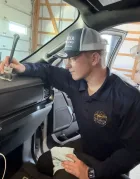
High-temperature steam penetrates fabric fibers and emulsifies the oily smoke deposits on contact. Premier uses the McCulloch MC1385 at 212°F across all interior surfaces, carpets, seats, door panels, dash, headliner edges, and every accessible seam.
Carpet and Fabric Extraction
After steam treatment, the commercial shop vac extracts the loosened contamination from carpet pile and seat fabric. This physically removes the material rather than leaving it to re-deposit.
Enzyme Treatment on Fabric Surfaces
Enzyme-based fabric cleaners (such as a professional carpet-extraction formula) break down organic compounds at the molecular level rather than just encapsulating them. Applied to carpets and seats, allowed to dwell, then extracted, this step handles the odor compounds that survive the initial steam pass.
HVAC, The Step Most Detailers Skip
The HVAC system recirculates cabin air across the evaporator core and through duct surfaces. In a smoker's car, these surfaces accumulate the same oily deposits as the visible interior.
Realistic expectation: On a vehicle with heavy long-term smoke exposure, a single deep clean reduces the odor by 70 to 85%. A second treatment 2 to 3 weeks later, after heat cycling allows remaining deep deposits to migrate to the surface, typically eliminates the rest. One-treatment complete elimination is realistic on vehicles with light to moderate smoke exposure.
How Premier Handles Smoke Odor in Johnson County
Premier's Interior Reset process, steam, extraction, enzyme treatment, and full surface wipe-down, addresses smoke odor at the source. For vehicles with significant smoke exposure, the service includes treatment of all accessible fabric surfaces, headliner edges, and hard plastics.
If you are buying a used vehicle in Johnson County, from a dealership or private seller, and suspect smoke exposure, a pre-purchase detail assessment is worth doing before the purchase closes. The level of smoke contamination affects what the remediation will actually cost.
| Service | Sedan | SUV / Truck |
|---|---|---|
| Interior Reset (vacuum, steam, extraction, plastics, glass) | $225 | $275 |
| Full Premier Detail (Interior Reset plus exterior hand wash and Protector Wax) | $350 | $400 |
Premier Detailing Services
Frequently Asked Questions
How much does mobile car detailing cost in Johnson County, KS?
Premier Detailing charges $225 for an Interior Reset (sedan) and $275 for SUVs. A Full Premier Detail including an exterior hand wash and Protector Wax is $350 for sedans and $400 for SUVs.
Does Premier Detailing come to my home?
Yes. Premier Detailing is a fully mobile service.
How do I book a mobile car detail in Johnson County?
You can book online at premierdetailingllc.com or call and text (913) 391-1868. Online booking is available 24/7.